Introduction
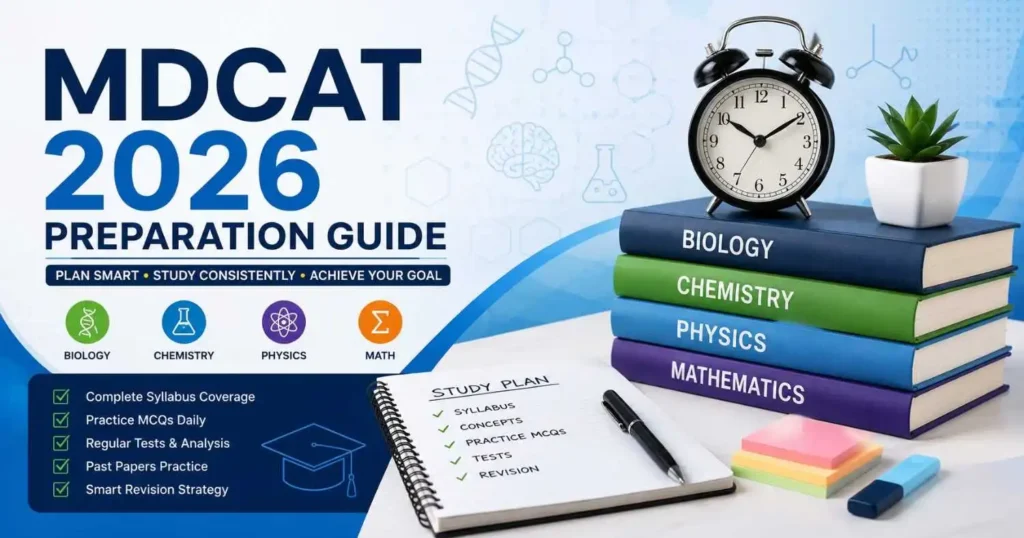
The Medical and Dental College Admission Test (MDCAT) is the most competitive entry test for medical colleges in Pakistan. Every year, over 200,000 students appear for MDCAT, but only a fraction secure admission in public and private medical universities. With MDCAT 2026 expected in August/September 2026, now is the perfect time to start your preparation.
This guide covers everything you need: updated syllabus, smart study techniques, past paper analysis, time management, and common mistakes to avoid.
H2: MDCAT 2026 – Key Updates
As of 2025, PMDC (Pakistan Medical & Dental Council) has standardized MDCAT across all provinces. Expected structure:
Component Details
Total MCQs 200
Duration 3.5 hours
Passing marks 60% (but competitive score >85%)
Negative marking No
Difficulty level Moderate to high Subject-wise breakdown (approx)
Biology: 80 MCQs
Chemistry: 60 MCQs
Physics: 40 MCQs
English: 20 MCQs
Logical Reasoning: 20 MCQs
Important: Syllabus is based on FSC (Pre-Medical) Part I & II books (PTB and federal board). No major change expected for 2026.
Complete MDCAT Syllabus 2026
Biology (80 MCQs)
Cell biology
Biological molecules
Enzymes
Bioenergetics
Prokaryotes & eukaryotes
Human physiology (digestion, circulation, respiration, excretion, nervous system, reproduction)
Coordination & control
Evolution & genetics
Ecology
Chemistry (60 MCQs)
Physical chemistry (states of matter, thermochemistry, electrochemistry, chemical kinetics)
Inorganic chemistry (periodic table, s/p-block elements, transition metals)
Organic chemistry (hydrocarbons, alkyl halides, alcohols, phenols, aldehydes, ketones, carboxylic acids, polymers)
Physics (40 MCQs)
Measurements
Motion & force
Work, energy & power
Circular motion
Oscillations & waves
Optics
Electrostatics & current electricity
Electromagnetism Modern physics
English (20 MCQs)
Vocabulary (synonyms, antonyms)
Grammar (tenses, subject-verb agreement, prepositions)
Sentence correction
Reading comprehension
Logical Reasoning (20 MCQs)
Analytical reasoning
Critical thinking
Pattern recognition
Data sufficiency
10 Proven Tips to Score 90%+ in MDCAT 2026
1. Start with the Syllabus
Print the official PMDC syllabus. Tick each topic as you cover it. Never study outside the syllabus.
2. Master FSC Textbooks First
MDCAT is 90% from FSC books (especially Punjab Textbook Board). Read each line – even the “Did you know?” boxes. Many MCQs come from these.
3. Solve Past Papers (Last 5 Years)
Download MDCAT past papers from 2021-2025. Solve them under timed conditions. You’ll notice repeated patterns:
20% MCQs repeat with changed values
30% are direct statements from textbooks
4. Use a Timer for Every Practice Session
Train your brain for 3.5 hours. Sit in a quiet room. No phone. No breaks. After 3 papers, your stamina will improve.
5. Focus on Biology – High Yield
Biology carries 40% weightage. Topics like human physiology, genetics, and biotechnology appear most often. Make flashcards.
6. Don’t Ignore Physics & Chemistry
Many students neglect physics. But 40 MCQs can boost your aggregate. Focus on formulas (Physics) and reaction mechanisms (Chemistry).
7. Weekly Mock Tests from October 2025
Join a test series (e.g., KIPS, STEP, NEARPEAR) or use free online mock tests. Analyze every mistake.
8. Create an Error Log
Keep a notebook only for wrong answers. Revise it every Sunday. This alone can increase your score by 10-15%.
9. Improve Speed with Logical Reasoning
Logical reasoning MCQs are easy but time-consuming. Practice 20 MCQs daily for 2 months. Aim for 18/20.
10. Stay Consistent – 4 Hours Daily
Don’t study 12 hours one day and zero the next. 4 hours daily for 6 months is better than 10 hours for 2 months.
Question-Answer Section (Google Snippet Optimized)
Q1: Is MDCAT 2026 difficult?
A: MDCAT is moderately difficult. The main challenge is time pressure – 200 MCQs in 3.5 hours means 1 minute per MCQ. With 6 months of focused preparation (4-5 hours daily), an average student can score 85%+.
Q2: Can I prepare for MDCAT without coaching?
A: Yes. Many toppers prepare at home using FSC books, YouTube lectures (e.g., Physics Wallah, FreeStudy.pk upcoming videos), and free online mock tests. Coaching helps with discipline but is not mandatory.
Q3: How many times can I attempt MDCAT?
A: PMDC allows 3 attempts (one per year). If you fail to get admission after 3 attempts, you cannot appear again.
Q4: Which past papers are most important?
A: Focus on MDCAT 2023 and 2024 (most relevant syllabus). Also solve UHS (University of Health Sciences) past papers from 2019-2022.
Q5: What is the passing marks for MDCAT 2026?
A: Minimum passing is 60% (120/200), but for admission in a government medical college, you need 85%+ in MDCAT plus 90%+ in FSC.
Sample Study Schedule (6 Months Plan)
Month Focus Area Daily Hours
Month 1 Biology (first half) + Chemistry (physical) 4
Month 2 Biology (second half) + Chemistry (organic) 4
Month 3 Physics (complete) + English 4
Month 4 Revision of all subjects + Past papers (2019-2021) 5
Month 5 Full syllabus mock tests (3 per week) + Error log 5
Month 6 High-yield topics + MDCAT 2023-2025 papers 4
Best Resources for MDCAT 2026 (Free & Paid)
Free Resources:
YouTube: FreeStudy.pk (coming soon), Physics Wallah, Dr. Hammad’s lectures
Websites: Past papers from ilmkidunya, taleem360
Mobile apps: MDCAT Prep (Google Play)
Paid Resources:
KIPS MDCAT book (Rs. 1,500)
STEP MCQs bank
NEARPEAR test series
Common Mistakes to Avoid
❌ Skipping FSC textbooks – Coaching notes are not enough.
❌ Ignoring time management – Solve MCQs with a stopwatch.
❌ Not taking mock tests – Without mocks, you’ll panic on exam day.
❌ Overloading with multiple books – Stick to 1-2 sources.
❌ Leaving logical reasoning for last – Practice it weekly.
Conclusion
MDCAT 2026 is a marathon, not a sprint. Start early, follow the syllabus, solve past papers, and track your progress. With consistent effort, you can secure admission in top medical colleges like King Edward Medical University, Dow University, or Ayub Medical College.
Bookmark this guide and share with friends. For video lectures and free mock tests, stay tuned to FreeStudy.pk.